To start, let's read the poem. But don't let's read it silently--it should be read aloud for the full experience (I wrote that, primarily, so I could use the phrase 'don't let's').
Out, Out-
Robert Frost
The buzz-saw snarled and rattled in the yard
And made dust and dropped stove-length sticks of wood,
Sweet-scented stuff when the breeze drew across it.
And from there those that lifted eyes could count
Five mountain ranges one behind the other
Under the sunset far into Vermont.
And the saw snarled and rattled, snarled and rattled,
As it ran light, or had to bear a load.
And nothing happened: day was all but done.
Call it a day, I wish they might have said
To please the boy by giving him the half hour
That a boy counts so much when saved from work.
His sister stood beside them in her apron
To tell them "Supper." At the word, the saw,
As if to prove saws knew what supper meant,
Leaped out at the boy's hand, or seemed to leap--
He must have given the hand. However it was,
Neither refused the meeting. But the hand!
The boy's first outcry was a rueful laugh,
As he swung toward them holding up the hand
Half in appeal, but half as if to keep
The life from spilling. Then the boy saw all--
Since he was old enough to know, big boy
Doing a man's work, though a child at heart--
He saw all spoiled. "Don't let him cut my hand off--
The doctor, when he comes. Don't let him, sister!"
So. But the hand was gone already.
The doctor put him in the dark of ether.
He lay and puffed his lips out with his breath.
And then--the watcher at his pulse took fright.
No one believed. They listened at his heart.
Little--less--nothing!--and that ended it.
No more to build on there. And they, since they
Were not the one dead, turned to their affairs.
Admittedly, I don't much care for poetry. I probably don't much care for it because I find it difficult--both to read and to write. Despite my general apathy toward poetry, I have always loved most poems by Robert Frost. I feel tragically cliché for so liking Frost, but I can't lie.
I hadn't encountered this poem until it was read to me by my lit. theory professor this summer semester. He, being fairly open with his emotions, nearly wept while reading this short, sparkling example of blank verse and I was certainly affected as well. We used this poem in a deconstructive exercise and the poem is very open to various theoretical interpretations but I have trouble getting into theory because the story of the poem is so tragic. Life lost, youth wasted, familial exploitation, death. I don't know what more to say so I'll just mention another Frost poem I love: "Home Burial."
18 June 2008


04 June 2008
A Few of My Favorite Things

So a few weeks ago I signed up for the John McCain e-mail list. I figured it would be a nice way to inform myself on his policies and such. It has proven a wise decision. Today, I got an e-mail linking to this newly launched section of McCain's website: The Decision Center
I'm not a fan of campaigning against a candidate, but I must admit that the various McBush sites are rather amusing.
02 June 2008
Libra
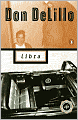
I fear that many of my literature-based posts in the future may deal with Don DeLillo. I've all but committed myself to focusing on him for my master's thesis so I'm working to read as many of his works as possible over the summer. I recently finished the novel Libra and then briefly started Players. Deciding that I need a brief break from DeLillo, I began Gravity's Rainbow by Thomas Pynchon. Yes, yes--I'm very PoMo-ey this summer and I'm loving it.
In great news, too, my first choice professor to direct my thesis tentatively said yes. He has published a few books on postmodernism and has unique views of postmodernism--specifically his notion of the romantic metaphysics of DeLillo's fiction. I'm very much looking forward to working on this project for about a year--wish me luck.
On to the novel:
Libra (published in 1988) is DeLillo's quasi-historical account of the JFK assassination. He focuses on the mindset of Lee Harvey Oswald and the years leading up to the national tragedy. Both the forward and afterward, by the author, go through great pains to state that the novel is purely fictional with a tinge of historical fact. My favorite portion of the work is DeLillo's exploitation of the ambiguity of nomenclature.
There's not much more to say about the novel other than it is aesthetically wonderful. It's not as if there is a secret ending to the story; I suppose that's the problem one runs into when writing semi-historical fiction. If Philippa Gregory can be considered successful (I suggest that you never pay money to see The Other Boleyn Girl, it's awful) then DeLillo should certainly be considered masterful.
22 May 2008
We Are Scientists

Since this is Thursday and I'm trying to slowly get back into a groove of regular writing, I'm supposed to write about something music related. I don't have much to say about them, but I'm really enjoying the band We Are Scientists as of late. I heard their song, "Let's See It," on WXPN and it was immediate wonder. Give them a listen, let's hope you'll like it.
On to bigger and better news.
Many months ago I decided that on my three week break from classes that I would catalogue and organize our library. I did a minimal amount of research and discovered Library Thing. Along the right side of the blog is a random list of the books in my library. I also picked up a bar code scanner that made putting books into my online library easy-as-pie. There are many different ways it allows you to organize your books. As a true nerd, I've put mine in Dewey decimal order. Last night I took all my books off their shelves and organized them--it's glorious. I encourage you to organize your library. For me, it's been nice to discover some books I had forgotten and to see what books the wife brought to our library. It's good to share.
19 May 2008
The Buddha of Suburbia

It is curious to me that I will often begin reading a novel mostly for pleasure and discover that it perfectly fits into something I need for a paper. That is exactly what happened with the novel The Buddha of Suburbia (henceforth TBS) by Hanif Kureishi. The professor for my Post-Colonial Lit. class assigned the short story "My Son the Fanatic" and the movie My Beautiful Laundrette (both written by Kureishi) for class discussion and I ended up writing the primary paper for the class on works by Kureishi (namely TBS, The Black Album, and Intimacy) so it isn't fair to imply that the reading of TBS was my own idea; but I hadn't intended to write my paper on him at that point.
I suppose I should start with some biographical information about Kureishi. He was born in England to a Pakistani father and an English mother. His parentage is, in my opinion, the driving force of his characterization. Many of his primary characters have similar parentage and suffer through some form of identity conflict. The main focus of my paper was a juxtaposition of Kureishi's work with Salman Rushdie's notion of an imaginary homeland for first generation British emigrants. Kureishi, as a second generation British man, does not experience the same conflicts as Rushdie, as a first generation emigrant author. The three works by Kureishi I covered can be seen as a series of a bildungsroman story of his own life through his chosen characters. It's difficult to analyze Kureshi because one cannot determine what, in the lives of his characters, belongs to the author's life and what is imaginary.
Anyway, I've been a lit. nerd for long enough, so let's move on to TBS.
The novel was Kureishi's literary break-out and was first published in 1990 (My Beautiful Laundrette was released in 1985) and it brought Kureishi into the international spot-light. The novel's main character is Karim, a young man (16, I believe) living in the London suburbs who has the same parentage as Kureishi. He struggles to find his own place in the suburbs so he decides to move to urban London to try his hand in the theatre. He finds success, but must compromise some of his better judgment along the way. It is an interesting story and an even more fascinating insight into the struggles of a young British-born South Asian man finding his place in a post-colonial world.
ps- The accompanying picture is a shot of Kureishi's home office and library. I'm quite jealous.
09 May 2008
Outlook
It was recently brought to my attention that I only consume political news from left-leaning sources. While that is pretty much fine with me since I'm fairly left leaning as far as most political issues are concerned, but it doesn't make me a properly informed individual.
Most of my news consumption happens at work, online. If there are any quality, right-leaning political websites out there, I would appreciate you letting me know where to look. This isn't an effort to learn more about the other side to better be able to attack them, but I think it's only fair that I look at issues objectively and base my views on a broad spectrum of information.
Thanks, in advance, for the ideas.
Most of my news consumption happens at work, online. If there are any quality, right-leaning political websites out there, I would appreciate you letting me know where to look. This isn't an effort to learn more about the other side to better be able to attack them, but I think it's only fair that I look at issues objectively and base my views on a broad spectrum of information.
Thanks, in advance, for the ideas.
Subscribe to:
Posts (Atom)

 Posts
Posts


