"I reject the notion of football as warfare. Warfare is warfare. We don't need substitutes because we've got the real thing."
-Don DeLillo in End Zone
Showing posts with label Don DeLillo. Show all posts
Showing posts with label Don DeLillo. Show all posts
08 November 2008


13 August 2008
Strange indeed
It's curious that after purchasing all but two of DeLillo's fifteen novels, one meeting with my thesis supervisor convinces me to focus my work on one of the books that I do not own.
"The best laid schemes o' Mice an' Men, gang aft agley."
"The best laid schemes o' Mice an' Men, gang aft agley."
Don DeLillo on the role of a writer
Responding to being called a 'bad citizen' by George Will in response to his novel Libra:
"I don't take it seriously, but being called a 'bad citizen' is a compliment to a novelist, at least to my mind. That's exactly what we ought to do. We ought to be bad citizens. We ought to, in a sense that we're writing against what power represents, and often what government represents, and what the corporation dictates, and what consumer consciousness has come to mean. In that sense, if we're bad citizens, we're doing our job.
-Don DeLillo
"I don't take it seriously, but being called a 'bad citizen' is a compliment to a novelist, at least to my mind. That's exactly what we ought to do. We ought to be bad citizens. We ought to, in a sense that we're writing against what power represents, and often what government represents, and what the corporation dictates, and what consumer consciousness has come to mean. In that sense, if we're bad citizens, we're doing our job.
-Don DeLillo
11 August 2008
Underworld
 After spending the bulk of my summer (the time I could afford to read more for pleasure than for class) working through the book, I've finally finished Underworld by Don DeLillo. I only say 'finally' because the book weighs in at 827 pages and lasted longer than I may have wanted it to. Turns out it was worth the time I put into it. Published in 1997, this novel is considered by many to be his magnum opus and it reads like a US cultural history from the 1950s through the mid-90s.
 The novel opens with a boy named Cotter Martin hopping the fence to sneak into the 1951 NLCS game between the New York Giants and the Brooklyn Dodgers (interestingly, both teams have moved to California. New York is, apparently, an awful place to be). The center of the book is the ball that was struck during the Shot Heard 'Round the World to end the game. The primary character is Nick Shay--a waste management executive living in Phoenix--and the authorial voice constantly vacillates from first to third person never allowing the reader a comfortable sense of the narrator. Along with Nick, a character of fiction, DeLillo employs actual historical figures such as J. Edgar Hoover, Truman Capote, and Lenny Bruce.
DeLillo says that he got the idea to call his novel Underworld when thinking about buried plutonium which got him thinking about Pluto, the god of the underworld. Though the fascination of Hoover, DeLillo uses the painting The Triumph of Death by Bruegel to introduce his constant theme that all plots lead to death. DeLillo first posits this notion in his novel Libra (his take on the JKF assassination) and it plays a major role in the bulk of his later fiction. Much of his work from the mid-80s on explores what effect death (not only dealing with the death of others, but the effect the fear of death has on the living) has on his characters.
I won't much go into plot points in fear of giving away spoilers so I'll just say that it is most definitely worth reading.
I do want to tough on DeLillo's style. Whether he is considered postmodern, Romantic, or anything else, he's a great writer. His style is slightly varied from novel to novel but it always remains true to what you expect from DeLillo. His characters, despite a consistent lack of description, remain vibrant and rarely flat. He's occasionally difficult to follow but one can always find a way back in to his world.
I really need to end this unabashed author-crush I have on DeLillo before I begin writing my thesis.
02 June 2008
Libra
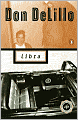
I fear that many of my literature-based posts in the future may deal with Don DeLillo. I've all but committed myself to focusing on him for my master's thesis so I'm working to read as many of his works as possible over the summer. I recently finished the novel Libra and then briefly started Players. Deciding that I need a brief break from DeLillo, I began Gravity's Rainbow by Thomas Pynchon. Yes, yes--I'm very PoMo-ey this summer and I'm loving it.
In great news, too, my first choice professor to direct my thesis tentatively said yes. He has published a few books on postmodernism and has unique views of postmodernism--specifically his notion of the romantic metaphysics of DeLillo's fiction. I'm very much looking forward to working on this project for about a year--wish me luck.
On to the novel:
Libra (published in 1988) is DeLillo's quasi-historical account of the JFK assassination. He focuses on the mindset of Lee Harvey Oswald and the years leading up to the national tragedy. Both the forward and afterward, by the author, go through great pains to state that the novel is purely fictional with a tinge of historical fact. My favorite portion of the work is DeLillo's exploitation of the ambiguity of nomenclature.
There's not much more to say about the novel other than it is aesthetically wonderful. It's not as if there is a secret ending to the story; I suppose that's the problem one runs into when writing semi-historical fiction. If Philippa Gregory can be considered successful (I suggest that you never pay money to see The Other Boleyn Girl, it's awful) then DeLillo should certainly be considered masterful.
Subscribe to:
Posts (Atom)

 Posts
Posts


