Showing posts with label PoMo. Show all posts

02 June 2008

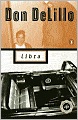
Libra


I fear that many of my literature-based posts in the future may deal with Don DeLillo. I've all but committed myself to focusing on him for my master's thesis so I'm working to read as many of his works as possible over the summer. I recently finished the novel Libra and then briefly started Players. Deciding that I need a brief break from DeLillo, I began Gravity's Rainbow by Thomas Pynchon. Yes, yes--I'm very PoMo-ey this summer and I'm loving it.


In great news, too, my first choice professor to direct my thesis tentatively said yes. He has published a few books on postmodernism and has unique views of postmodernism--specifically his notion of the romantic metaphysics of DeLillo's fiction. I'm very much looking forward to working on this project for about a year--wish me luck.


On to the novel:


Libra (published in 1988) is DeLillo's quasi-historical account of the JFK assassination. He focuses on the mindset of Lee Harvey Oswald and the years leading up to the national tragedy. Both the forward and afterward, by the author, go through great pains to state that the novel is purely fictional with a tinge of historical fact. My favorite portion of the work is DeLillo's exploitation of the ambiguity of nomenclature.
There's not much more to say about the novel other than it is aesthetically wonderful. It's not as if there is a secret ending to the story; I suppose that's the problem one runs into when writing semi-historical fiction. If Philippa Gregory can be considered successful (I suggest that you never pay money to see The Other Boleyn Girl, it's awful) then DeLillo should certainly be considered masterful.

10 March 2008

White Noise

On most issues of literature, if Harold Bloom speaks I listen. You may or may not have noticed, but I took the title of this blog from Bloom's theory of poetry. While I don't agree with some of his theories (especially regarding the origin of the Old Testament), I had to pay attention when I discovered that Bloom listed (in his opinion) the four major American novelist of our time: Don DeLillo, Thomas Pynchon, Philip Roth, and Cormac McCarthy. Since my professional goal in life is to live and work as a scholar of modern/post-modern American literature, I have set on a mission to read the vast body of work these four novelists have produced. While I am not a strict worshipper of Bloom's notions, I believe that his favorites are good places to start--if only I could love Shakespeare like he does.

Anyway, on to the novel.

I recently finished White Noise by Don DeLillo and thoroughly enjoyed it. A few friends have told me that the novel is a great starting point into DeLillo's work, and I agree. It is a nice representation of his voice and late enough into his career that he has discovered his unique voice. Some complain that his earlier novels lack a certain element of finish; but such accusations cannot be waged against White Noise--if anything, the novel is polished.

The central character is J.A.K. Gladney, the dean of a Hitler Studies department and the originator of the field of study. Gladney has had many wives and his many wives have also had many husbands--a typical post modern family. While the concept of the characters can seem a bit campy, DeLillo toes the line of believable quite nicely and the novel never quite jumps the shark, much to my delight. The novel, essentially, tells the story of a typical family and their typical struggles with everyday life. I'll say no more, mostly because I want you to read it.

DeLillo has been accused of boiling down modern (as in present day, not the Modernist period)American life to daily boredom comprised of television, consumption, metro, boulout, dodo. White Noise certainly falls into this category, but I find no fault in the portrayal. He approaches common problems with honesty, humor, and wit that I haven't encountered before.

I will admit that I haven't read any academic criticism of DeLillo's work, but I'll be getting there as soon as school/life slows down. I'm still working out my own feelings about the novel and I want to give my mind a chance before Bloom and others take over.